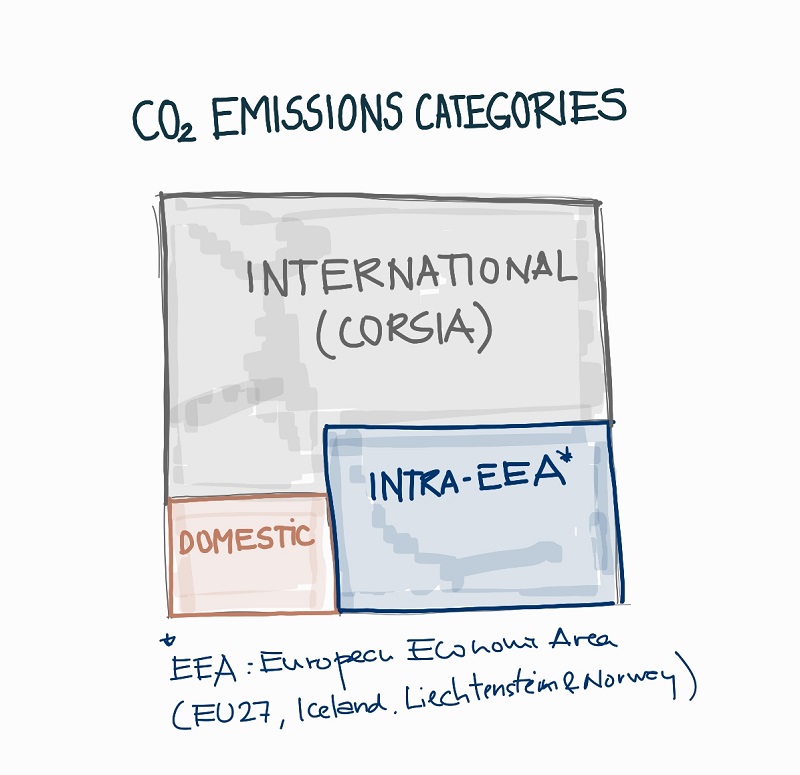
Airlines CO2 emissions for European airlines can be divided into three categories: CO2 emissions generated on domestic routes, intra-European routes, and International routes. Airlines’ CO2 emissions are reported to the corresponding authorities of each EEA member. For example, in Spain it is the Agencia Española de Seguridad Aére (AESA), which is in charge of collecting all emissions from airlines registered in Spain on a yearly basis and reporting them to the EU ETS Registry and the ICAO CORSIA Central Registry (CCR). Airlines registered in the UK need to report to the UK ETS registry. From January 2025, Non-CO2 emissions will be also reported to the EU-ETS Scheme.
Public companies in Europe, including airlines, started to publish environmental information in 2018, as a consequence of the Non-Financial Reporting Directive (NFRD) 2014/95/EU. This has evolved with the new Corporate Sustainability Reporting Directive (CSRD) (EU) 2022/2464. The new rules will need to be applied for the first time in the 2024 financial year, for reports published in 2025.
Airline groups will require their subsidiary airlines to report on the countries where they are registered. For example, in the International Airlines Group (IAG), member airline Iberia will do the reporting in Spain, and the group member Aer Lingus will do the reporting in Ireland. Both, together with the other group members, will also be reporting sustainability metrics internally within the group, normally on a quarterly basis, and the group will publish the non-financial report, labelled as Consolidated Stament of Non-Financial Information by IAG.